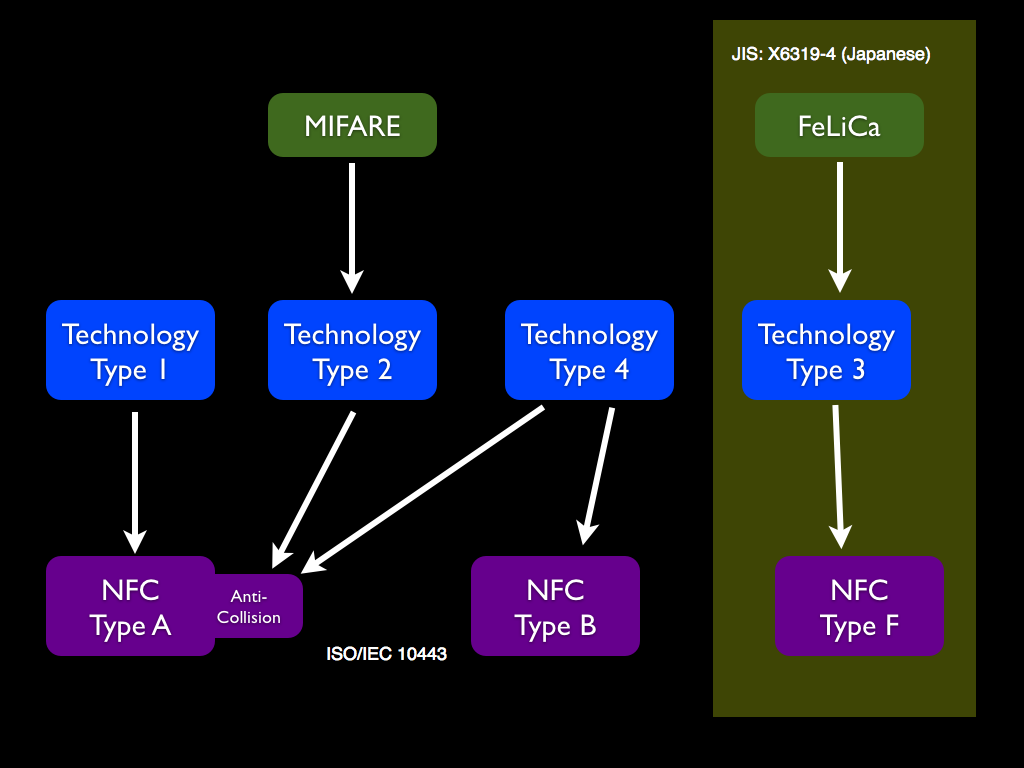
There are three major classifications of NFC communication, NFC-A, NFC-B and NFC-F. Each present their own unique advantages and disadvantages.
There are three major classifications of NFC communication, NFC-A, NFC-B and NFC-F. Each present their own unique advantages and disadvantages.
 Miller Encoding
Encoding is the technical process in which data is transformed into machine language and transferred from one NFC tag to another, and can be thought of as the lowest level at which NFC truly communicates. Miller encoding is the first of the two primary encoding styles used in all three of the major signaling types. There are three rules when discussing Miller encoding: If bit is 0, do not invert the signal, if bit is 0 but previous bit was also 0, invert the signal at the edge of the bit, and ff bit is 1, invert the signal at the middle of the bit (this is the delayed transition).
 Manchester Encoding
Compared to miller encoding, this style of encoding is much easier to understand. If the modulated signal is at the lower point, this being 10% lower than a higher value, than it is 0. If it is at the higher value, it is considered to be a 1.